Brighton by Train
An hour south, London’s beach town runs on pebbles, piers, and a Regency king’s magnificent scandal of a palace — Indian outside, Chinese inside, indefensible throughout. Bring sandals, not sandcastle plans.
The short version
- Trains run from Victoria, Blackfriars, and St Pancras to Brighton in about an hour at metro-like frequency — nationalrail.co.uk — with the sea a ten-minute downhill walk from the station.
- The Royal Pavilion is George IV’s seaside pleasure palace: Indo-Saracenic domes outside, chinoiserie delirium inside — the Banqueting Room’s dragon chandelier the single most committed object in Regency England — around £17–18 at brightonmuseums.org.uk.
- The beach truth per the alarm: pebbles, ranked and rolling, with the swimming real and the barefoot walk a penance — sandals handle it, deckchairs rent by the hour, and the shingle’s rattle in the backwash is the town’s soundtrack.
- The Lanes and North Laine split the browsing: the Lanes’ twisting jewelry-quarter alleys for the antique register, North Laine’s painted streets for the independent-and-vintage one — adjacent, different, and both walkable in the same loop.
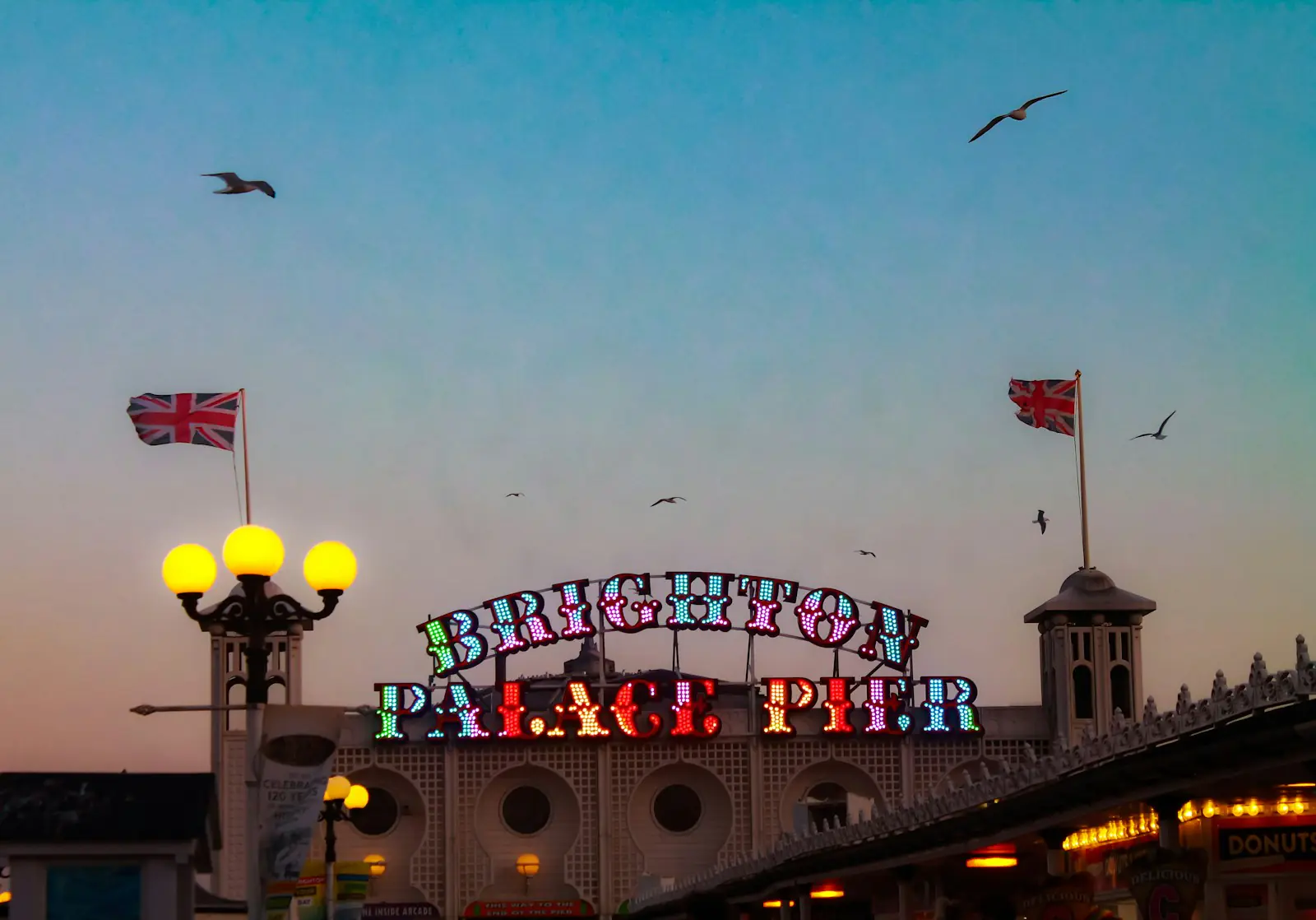
- The Palace Pier runs free at the gate with arcade-and-ride economics inside — doughnuts, gulls with criminal intent, and the Victorian ironwork doing the actual charm; the burned West Pier’s skeleton offshore is the town’s beautiful ruin.
- Winter dusk brings the starling murmurations wheeling over that ruin — thousands of birds folding the sky above the water, free nightly in the cold months, per the alarm’s stay-late clause.

Getting there
Three London terminals feed the line at turn-up frequency; the hour passes in Sussex green and arrives downhill from everything. The day needs no bookings — the Pavilion sells at the door outside peak weekends — and the alarm’s two truths (pebbles, palace) are the whole preparation. Evening trains run late enough for fish and chips at dusk and the starlings’ winter show; the last fast services are worth a glance on Sunday nights.
The day
Pavilion first while the morning is yours: the exterior’s dome ensemble, then the interior’s escalating commitment — the long gallery’s bamboo cast iron, the Banqueting Room under its dragon, the kitchen’s palm columns — Regency excess curated with a straight face and better for it. The garden and the Brighton Museum next door extend the ticket’s neighborhood. Lunch splits by register: the Lanes’ seafood institutions or North Laine’s café sprawl. The afternoon runs the seafront: pier walk with doughnut and gull-defense, pebble sitting with sandals vindicated, a swim for the committed, and the artists’ quarter arches between the piers. Browsing hours disappear into North Laine’s record-and-vintage grid. Dusk closes it — fish and chips on the shingle in summer, or winter’s murmuration over the West Pier ribs, the alarm’s free show, before the uphill walk to the train.
When to go
May through September runs full seaside voltage — warm shingle, open lidos, weekend crowds at capacity. Winter is the connoisseur’s Brighton: empty beach walks, the Pavilion nearly private, and the starlings’ dusk show at its peak — the alarm’s clause is a season, not a footnote. The Festival (May) and Pride (August) transform the town at booked-out scale, aimed for or around with intent. Sunny summer Saturdays bring half of London; the constant trains mean going midweek costs nothing.
Frequently Asked Questions
Why is the Pavilion a ‘scandal’?
George IV built a pleasure palace of borrowed exotica at staggering cost while Regent, for a life Parliament and press found indefensible — and Victoria sold it to the town as soon as decency allowed. Two centuries on, the indefensibility is the charm: it’s the most honest building about its own appetite in England.
Is the beach swimmable?
Genuinely — clean, lifeguarded in season at the central stretches, with the pebble entry sharp and the shelf quick. Swim shoes upgrade it from penance to pleasure. The paddling-toddler demographic does better at low tide’s sand margins or the lagoon.
Lanes or North Laine with limited time?
North Laine for the living town — independents, vintage, café tables in the street; the Lanes for the postcard tangle and the jewelry windows. They border each other, so ‘both, briefly’ is the honest answer in ninety minutes.
What happened to the West Pier?
Closed in 1975, then lost to storms and two fires in 2003 — the skeleton was left standing as the town’s accidental sculpture, and the starlings adopted it. Restoration talk ended long ago; the ruin’s second career is the better one.
Brighton or Canterbury from London?
Canterbury (documented on this network) for the cathedral and evensong’s free-entry trick; Brighton for sea air, the Pavilion, and browsing hours. Sacred versus seaside — both an easy hour, and the weather is a legitimate tiebreaker.