25 Interesting Hotels in London
Bank vaults, courtrooms, a war office, a hospital — and the grand survivors of 1837.
A bank headquarters, two magistrates’ courts, a war office, a hospital, and a brutalist council annexe all rent rooms in London tonight. The grand Victorian originals never stopped renting them.
Every hotel below has a story — who built it, what it used to be, or what happened inside. The list is grouped, not ranked. Each name links to the hotel’s own site, where the rate is current and the booking is direct.
The grand old ones
Brown’s · Mayfair
A retired valet named James Brown opened four Mayfair townhouses to guests in 1837, the year Victoria took the throne, and most histories count it London’s first hotel. Alexander Graham Bell demonstrated his telephone here in 1876, and Rudyard Kipling wrote The Jungle Book as a regular guest, by the hotel’s own records.
The Savoy · Strand
Richard D’Oyly Carte built the Savoy in 1889 with the profits from his Gilbert and Sullivan operas, and it opened as the first hotel in London lit throughout by electricity. Claude Monet painted the Thames from his room across three stays between 1899 and 1901. Since 1927, any party of thirteen in the restaurants dines with Kaspar, a two-foot wooden cat seated as the fourteenth guest with a napkin at his neck.
Claridge’s · Mayfair
Claridge’s has housed exiled royalty since the 1850s. The best story dates from 1945: suite 212 was declared Yugoslav territory for a day — by Churchill’s order, in the usual telling — so Crown Prince Alexander could be born on home soil. Historians have never produced the paperwork. The hotel tells the story anyway.
The Ritz · Piccadilly
César Ritz opened his London hotel in 1906 inside one of the city’s first major steel-framed buildings, dressed as a Parisian block on Piccadilly. Churchill, de Gaulle, and Eisenhower met here during the Second World War, by the hotel’s account. Tea in the Palm Court still runs on a dress code: jacket and tie, no jeans, no sneakers.
The Langham · Marylebone
The Langham opened in 1865 as one of Europe’s first purpose-built grand hotels. At a single dinner here in August 1889, J.M. Stoddart of Lippincott’s Magazine commissioned The Sign of the Four from Arthur Conan Doyle and The Picture of Dorian Gray from Oscar Wilde.
The Goring · Belgravia
The Goring opened in 1910 and has never left the founding family; the fourth generation runs it now. Kate Middleton spent her last night before the 2011 royal wedding here, and in 2013 it became the first hotel granted a royal warrant.
Used to be something else
The Ned · The City
Edwin ‘Ned’ Lutyens designed the Midland Bank headquarters in 1924; Soho House reopened it in 2017 as a hotel named after him. The banking hall, a city block of green verdite columns, holds most of the restaurants, and the bar downstairs sits inside the original vault — behind a 20-tonne steel door, with 3,000 safe-deposit boxes still lining the walls.
Raffles London at The OWO · Whitehall
The Old War Office went up on Whitehall in 1906, and Churchill kept an office here as Secretary of State for War. The building spent its whole working life closed to the public, then opened as a hotel in 2023 after an eight-year conversion. Film crews borrowed the exterior for Bond pictures for decades before a single guest checked in.
NoMad London · Covent Garden
Bow Street Magistrates’ Court processed Oscar Wilde, Emmeline Pankhurst, and the Kray twins from its spot opposite the Royal Opera House. NoMad turned the 1881 building into a hotel in 2021, kept the magistrates’ courtroom for events, and now operates under Hilton. A museum of the old police station stands next door.
The Dixon · Tower Bridge
Tower Bridge Magistrates’ Court opened in 1906 under architect John Dixon Butler and heard cases for a century. The hotel that took over in 2019 named itself after him and kept the courtroom proportions.
The Lanesborough · Hyde Park Corner
William Wilkins rebuilt St George’s Hospital at Hyde Park Corner in 1844, and patients filled the building until 1980. It reopened in 1991 as the Lanesborough, named for the viscount whose house stood here first in 1733. Butler service comes with every room.
Four Seasons Ten Trinity Square · Tower Hill
The Port of London Authority built this headquarters on Tower Hill in 1922, with Father Thames carved above the entrance. The reception for the United Nations General Assembly’s first session was held in the building in 1946. Four Seasons runs it now, facing the Tower of London.
The Standard · King’s Cross
Camden Council built its town-hall annexe in 1974, brutalist and widely disliked, and preservationists got it listed anyway. The Standard moved in for its first hotel outside the Americas in 2019 and painted the exterior lift red. Ride it up the outside of the building to the tenth floor.
Town Hall Hotel · Bethnal Green
Bethnal Green raised this town hall in 1910 and extended it in art deco in 1937; the council moved out and the building sat mostly dark for years. The hotel that opened in 2010 kept the council chamber, the marble, and the walnut, and film crews book it constantly.
St Ermin’s · Westminster
Churchill’s Special Operations Executive was organized in meetings at St Ermin’s in 1940, and intelligence officers worked floors of the building through the war. The hotel keeps a spy-history display by the lobby and beehives on the roof, and sells the honey downstairs.
Small, literary, strange
Hazlitt’s · Soho
Three Frith Street townhouses from 1718 carry the name of William Hazlitt, the essayist who died in one of them in 1830. The floors slope, the stairs creak, and the hotel fixed neither on purpose. Visiting authors leave signed first editions, and the sitting-room library keeps the collection.
The Rookery · Clerkenwell
These houses went up in 1764 on the edge of Smithfield, in the kind of district Victorians called a rookery — their word for a slum. The hotel kept the name and filled the rooms with four-posters and salvaged antiques, no two alike. The top suite looks across the rooftops to St Paul’s.
Batty Langley’s · Spitalfields
The owners of Hazlitt’s restored these 1724 Spitalfields houses and named them for Batty Langley, the Georgian author of builders’ pattern books. Doors hide behind bookcases, and the rooms keep the eighteenth-century look while the plumbing stays modern.
Georgian House · Pimlico
This 1851 Pimlico townhouse has taken guests for more than a century. Below stairs it keeps the Wizard Chambers — candlelit rooms with four-posters, cauldrons, and potion bottles. The plain Georgian rooms upstairs cost less and skip the theatrics.
The Portobello · Notting Hill
The Portobello opened in Notting Hill in 1971 and spent the decades since housing touring musicians and the people photographing them. Room 16 keeps its famous round bed. The hotel lets the legends circulate without confirming any of them.
Blakes · South Kensington
Anouska Hempel, designer and former Bond girl, opened Blakes in 1978, and hotel histories routinely call it the world’s first boutique hotel. Every room is a separate set — black lacquer in one, Ottoman silks in the next — inside a row of South Kensington townhouses.
Landmarks in their own right
St Pancras Renaissance · King’s Cross
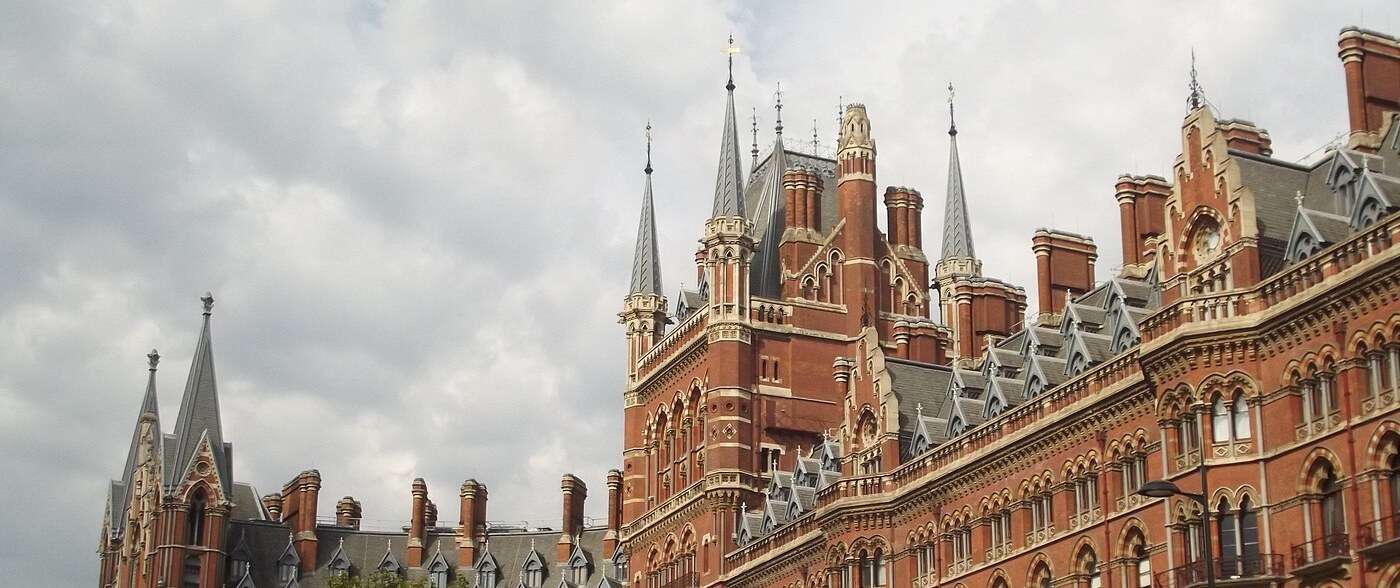
George Gilbert Scott’s Midland Grand opened at St Pancras station in 1873 and closed as a hotel in 1935. John Betjeman’s campaign stopped its demolition in 1967, and the building reopened as a hotel in 2011. The Spice Girls filmed Wannabe on the grand staircase in 1996, while the rooms still stood empty.
Shangri-La The Shard · London Bridge
The hotel runs from floor 34 to floor 52 of the Shard, with Western Europe’s highest hotel rooms by its own count. The pool on 52 faces the city through floor-to-ceiling glass.
Hotel Café Royal · Regent Street
The Café Royal served Regent Street from 1865 to 2008, with Oscar Wilde holding court at his regular table through the 1890s. David Bowie threw the farewell party for Ziggy Stardust here in July 1973. The hotel that opened in the building in 2012 kept the gilded Grill Room and renamed it for Wilde.
The Beaumont · Mayfair
Corbin and King, the restaurateurs behind the Wolseley, opened their only hotel in 2014 inside a 1926 former garage on a quiet Mayfair square. Antony Gormley’s ROOM crouches on the facade — a giant steel figure that is also a suite, and guests sleep inside it.
Frequently Asked Questions
Are these hotels ranked?
No. The groups sort them by character, and the order inside each group carries no meaning.
What made a hotel interesting enough for this list?
A story. Every entry was a bank, a court, a hospital, a war office, or a townhouse with a past — or it made history as a hotel. Comfort alone did not qualify a hotel.
Why are there no prices?
Rates change daily, and lists with prices go stale in a month. Every hotel name links to its own site, where the rate is current and the booking is direct.
Which hotel puts me closest to the day trips on this site?
Most trips here leave by train, and London’s terminals ring the center. St Pancras Renaissance sits inside a station; the Goring and St Ermin’s stand near Victoria; the Ned is a short walk from Liverpool Street.
Do the small hotels book out faster than the grand ones?
Usually. Hazlitt’s, the Rookery, Batty Langley’s, and the Portobello hold a few dozen rooms each and fill first. Book those before the grand ones.